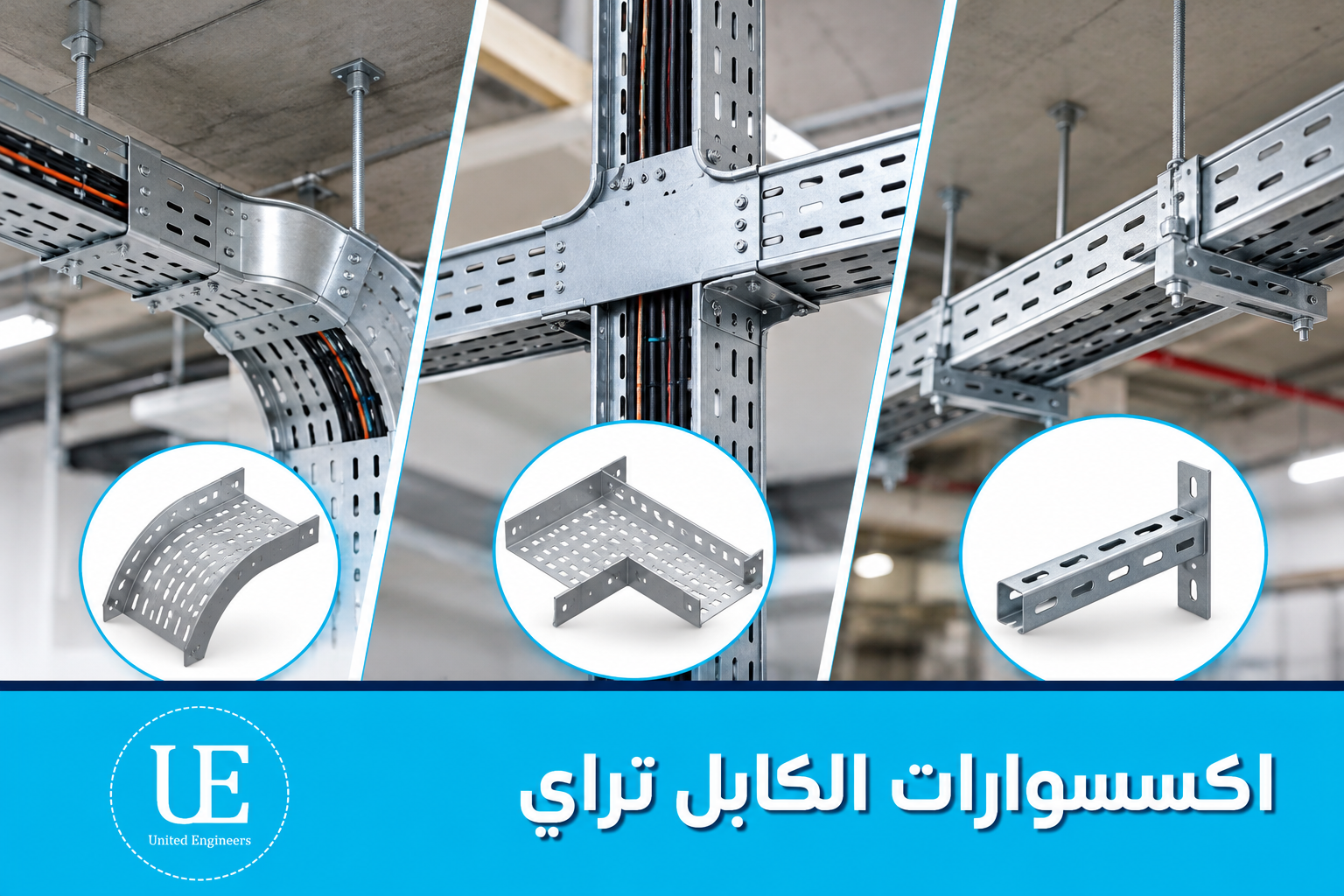
Cable Tray Accessories: Types, Uses and Selection Guide 2026
Cable tray accessories are an essential component of any cable management system. They play a vital role in securing tray runs, bearing mechanical loads, and facilitating changes in direction and elevation according to project specifications. Therefore, the quality of splice plates, fasteners, and support accessories is just as critical as the quality of the cable tray itself.
As a leading manufacturer, United Engineers (unitedengineers) provides a comprehensive range of cable tray accessories and support systems. Our portfolio includes elbows, tees, reducers, suspension systems, and protective components—available in diverse materials and finishes such as Pre-Galvanized, Hot-Dip Galvanized, Stainless Steel, and Aluminum to suit various project demands and environmental conditions in Cable tray Egypt applications.
Why Are Cable Tray Accessories Crucial in Electrical Installations?
Using high-quality cable tray accessories offers greater flexibility during the installation of cable management pathways, enabling contractors to seamlessly navigate site constraints, obstacles, and directional changes.
Proper fittings—such as splice plates, elbows, and reducers—guide cables horizontally and vertically in a safe manner. This significantly reduces the risk of sharp bends or mechanical stress that could otherwise damage cable insulation and internal conductors.
Furthermore, integrating the right Electrical cable tray accessories streamlines installation, simplifies maintenance, and accommodates future expansions while preserving the overall efficiency, safety, and reliability of the cable ecosystem.
To ensure efficient cable management and safe installation, explore the different cable trunk price and their applications to choose the most suitable system for your project.
Key Types of Cable Tray Accessories and Attachments
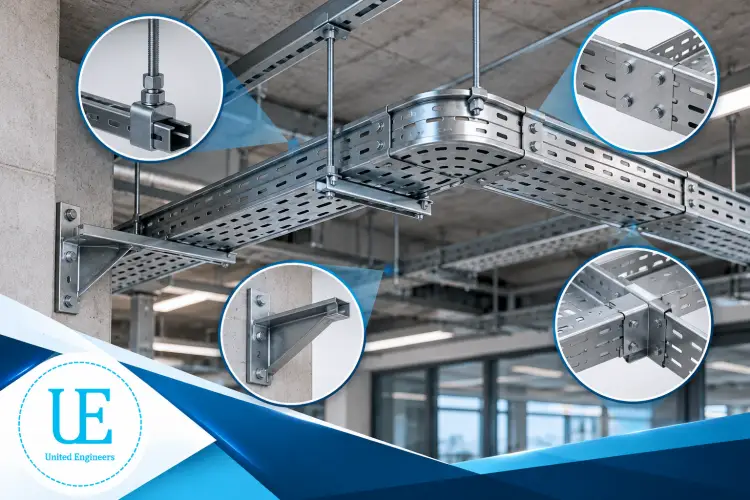
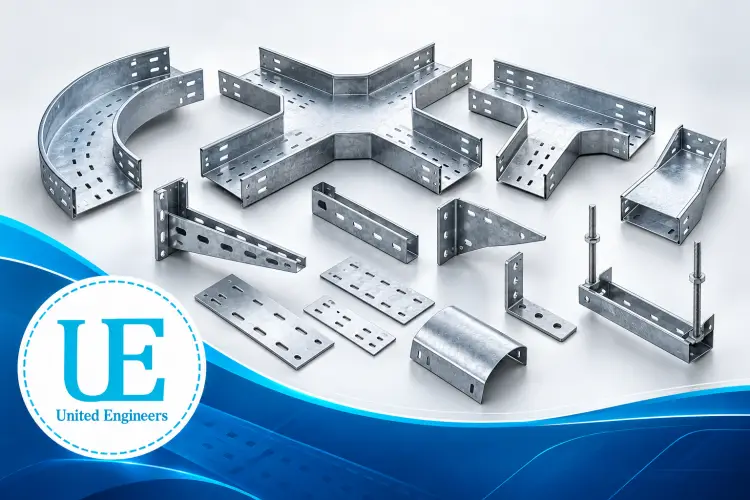
Cable tray accessories are designed to meet diverse layout requirements and engineering challenges. Each fitting performs a specific function, such as altering directions, branching pathways, adjusting tray width, joining sections, or protecting conductors. Selecting the correct accessory depends on the path design, cable volume and size, and environmental factors to ensure stable, long-term operation.
1. Cable Tray Bends and Elbows
Elbows are used to change the direction of a cable tray route safely and smoothly, minimizing mechanical strain on the enclosed wiring.
- Horizontal Elbows: Available in angles such as 90° and 45° to change directions within the horizontal plane.
- Vertical Inside & Outside Elbows: Used to transition between different elevation levels, enabling upward or downward runs.
2. Tees and Crosses
These fittings are utilized to branch and distribute cable runs from the main line into multiple secondary directions.
- Horizontal Tees: Allow for a 90-degree perpendicular branch off the main pathway.
- Horizontal Crosses: Enable four-way path distribution, ideal for complex power and data networks.
3. Reducers
Reducers adjust the width of the cable tray to match variations in cable capacity along the pathway.
- Straight (Concentric) Reducer: Reduces width equally from both sides, maintaining the central alignment of the tray run.
- Right Reducer: Keeps the right side straight while tapering the left side.
- Left Reducer: Keeps the left side straight while tapering the right side, typically used when aligning along walls or adjacent structures.
4. Splice Plates and Hinges
Splice plates are essential cable tray accessories used to connect straight tray lengths and fittings together, providing structural integrity and electrical continuity.
- Straight Splice Plates: Used to join linear tray sections using appropriate bolts and hardware.
- Adjustable & Expansion Splice Plates: Offer flexible joints at building expansion seams or along pathways requiring angular adjustments.
5. Cable Tray Covers
Covers are secured to the top of the tray using cover clamps to offer supplementary cable protection, especially in industrial or outdoor environments. These cable tray accessories shield cables against dust, debris, water, oils, physical impacts, falling objects, direct sunlight, and rodents.
The quality and durability of cable management systems depend on precise production processes, making it essential to understand cable tray factory and its role in industrial installations.
Cable Tray Support Systems
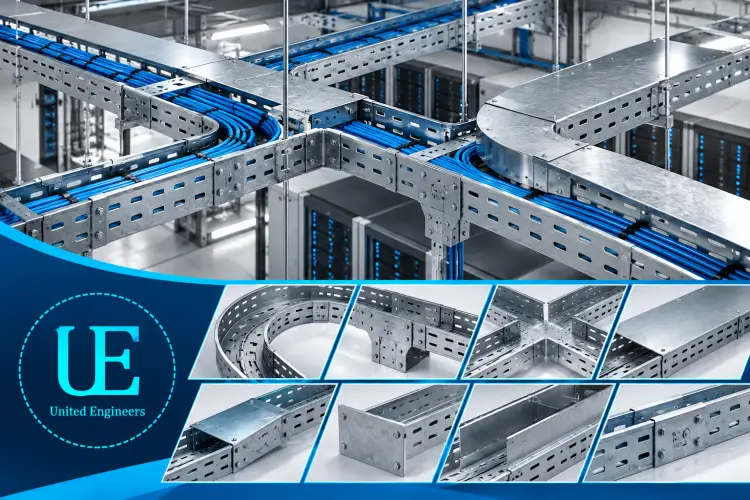
A reliable cable tray support system is indispensable for maintaining structural stability and safely carrying heavy cable loads. The optimal support method depends on the installation site, load weight, and the number of tray runs—whether mounted from ceilings, walls, or structural steelwork.
Suspension Systems
Suspension systems hang cable trays from ceiling slabs or structural beams, offering easy height adjustment and versatility.
- Trapeze Hangers: Consist of a horizontal C-Channel or Unistrut beneath the tray, suspended from both sides using threaded rods. This heavy-duty setup supports substantial loads and multi-tier tray arrangements.
- Center Hangers (Single Rod): Utilize a single central threaded rod. Ideal for light-to-medium loads, providing open side access for easy cable pulling and placement.
Wall Brackets and Cantilever Arms
Used when routing cable trays along walls or structural columns instead of suspending them from ceilings.
- Cantilever Arms: Metal bracket arms anchored directly to walls using expansion or anchor bolts. Available in various lengths to fit different tray widths.
- Vertical Channel Brackets: Unistrut channels are installed vertically on the wall, with cantilever arms attached to them. This system allows for convenient vertical adjustment between multiple tray tiers.
Threaded Rods and Mounting Hardware
Threaded rods are fundamental components of overhead suspension setups, available in standard diameters such as M8, M10, M12, and M16. They are typically manufactured from Pre-Galvanized or Hot-Dip Galvanized steel or Stainless Steel to withstand harsh conditions.
Key accessories include drop-in anchors, wedge anchors for concrete mounting, nuts and washers for level adjustments, rod couplers, and beam clamps for attaching to structural steel without drilling or welding.
Additional Protection and Anti-Vibration Accessories
For specialized engineering projects, additional hardware may be required:
- Seismic Sway Bracing: Restrains tray movement during seismic activity or severe vibration.
- Vibration Dampeners: Help absorb vibrations generated by nearby mechanical equipment.
Producing high-quality cable tray accessories requires accurate cutting, bending, and shaping processes, highlighting the importance of professional cable tray price list egypt in industrial manufacturing.
Why Choose United Engineers for Your Cable Tray Supplies?
United Engineers (unitedengineers) is a trusted manufacturing partner supplying high-quality cable tray accessories and structural support systems. By focusing on precision engineering and robust manufacturing, we meet the rigorous demands of modern infrastructure projects.
Key advantages of partnering with United Engineers include:
- Precision CNC Manufacturing: Advanced CNC cutting, punching, and bending technologies ensure accurate dimensions and effortless site installation.
- Premium Materials & Surface Treatments: High-grade materials with specialized finishes—including Pre-Galvanized, Hot-Dip Galvanized, and Stainless Steel—to prevent corrosion and extend service life.
- Extensive Range of Sizes & Thicknesses: A wide selection of profiles, dimensions, and gauge thicknesses designed for light-duty commercial to heavy-duty industrial applications.
- Rapid Supply & Delivery: High-volume production capacities and strict adherence to project delivery timelines keep your construction schedules on track.
- Compliance with Global Quality Standards: Rigorous quality control guarantees that every product meets mechanical load and operational safety requirements.
At United Engineers, we deliver complete cable management solutions that combine precision craftsmanship, corrosion resistance, and structural dependability for long-term operational success.
Frequently Asked Questions (FAQ)
Should the material of the accessories match the cable tray material?
Yes, it is highly recommended that Electrical cable tray accessories share the exact same material and surface finish (e.g., Hot-Dip Galvanized, Pre-Galvanized, or Stainless Steel) as the cable tray to prevent galvanic corrosion and ensure material compatibility.
How do I select the right elbow angle?
Selection depends on your routing layout:
- 90° Elbows: Best for sharp, direct 90-degree directional changes.
- 45° Elbows: Ideal for gradual directional changes, particularly when handling large-diameter cables with strict bend radius limits.
- Horizontal Elbows: Used for changing directions left or right within the horizontal plane.
- Vertical Elbows: Used for changing elevations up or down.