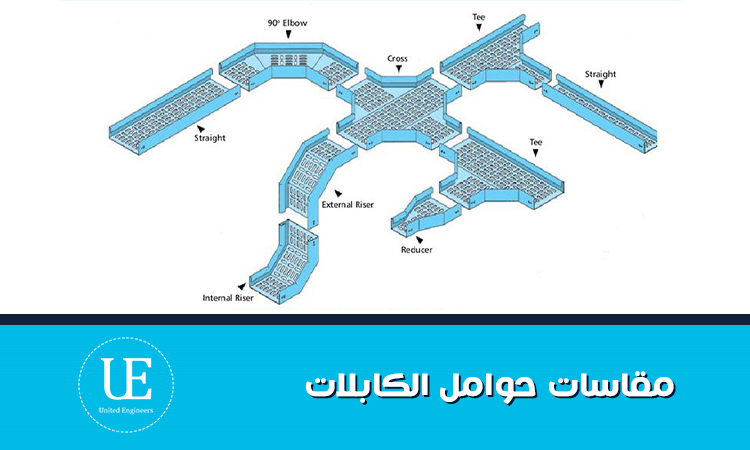
cable trays sizes
cable trays sizes play a fundamental role in organizing and distributing cables within industrial and commercial facilities and modern buildings. They are the safe path that protects wires from damage and facilitates future maintenance and expansion operations. The dimensions of cable trays are among the most important factors to consider when designing and installing, as they vary according to the type of project, the number of cables, and their electrical loads.
United Engineers offers a wide range of sizes to suit all types of installations, whether in factories, hospitals, or infrastructure projects, with the possibility of implementing customized designs according to each client's needs. Follow us to the end of the article to learn more details.
What are the specifications of cable trays?

All Types of cable trays One of the most important modern solutions for organizing and securing cable routes within industrial and commercial buildings and facilities is an integrated system that ensures cables are arranged in a safe and efficient manner. The cable carrier sizes are characterized by their high load-bearing capacity and rigidity, making them capable of supporting large quantities of cables without the risk of bending or collapse, which enhances safety and order within the work environment.
Metal cable trays sizes are typically made of galvanized steel or aluminum, giving them excellent resistance to rust and corrosion, making them ideal for use in harsh environments or those exposed to humidity and various weather conditions. They also feature a robust design capable of withstanding large loads and continuous operating conditions without being damaged or deformed.
These brackets are available in several designs and shapes to suit all applications, such as horizontal, vertical and composite systems, giving great flexibility in installation. Their ease of installation and modification also helps to facilitate maintenance work or the addition of new cables without the need for radical changes to the system.
Thanks to these advantages, metal cable trays sizes contribute to raising the level of safety within facilities and reducing the risks of tangling or wire damage, in addition to improving the overall appearance of the place and maintaining an organized work environment.
One of the leading companies in manufacturing and supplying this type of rack is United Engineers, which offers a wide range of sizes and designs according to the latest engineering standards to ensure the highest levels of durability and efficiency in use.
Cable holder sizes
The width of a cable trays sizes typically ranges between 100 mm and 900 mm, providing great flexibility in choosing the right size to accommodate different quantities of cables according to project needs.
As for depthIt rangesFrom 25 mm to 150 mm, which ensures adequate support for the cables inside the bracket while maintaining a balanced weight distribution.
The load capacity is determined based on the weight and number of cables and their total cross-sectional area to ensure stability and safety during operation. Specialized calculation programs, such as Excel spreadsheets, can also be used to accurately select the optimal size, in accordance with the technical and design specifications of each project.
The dimensions of cable trays and their technical specifications are also taken into account in determining the international standards and codes for cable tray systems, to ensure efficiency in performance, ease of installation, and compliance with approved safety and quality requirements in the market.
The effect of size on ventilation and ease of maintenance

The importance of electrical cable extensions lies in a number of key aspects that ensure the safety and efficiency of electrical systems within facilities, and these can be summarized as follows:
- Highly efficient transmission of electricity from the power source to the loads without significant loss of voltage or power.
- Protecting cables from external influences such as heat, humidity, mechanical or electrical shocks, and fire hazards.
- Organizing electrical connection routes to facilitate future maintenance or expansion work without complications.
- Reducing the likelihood of fires and electrical malfunctions that could cause material losses or damage to infrastructure.
- Reduced operating and maintenance costs thanks to reliance on proper wiring that reduces malfunctions and increases cable lifespan.
- It increases the value and efficiency of the facility, as proper electrical wiring is an indicator of the quality of implementation and the long-term safety of the infrastructure.
Cable Tray Factory
Which is the best cable tray manufacturer? United Engineers Company is considered unitedengineers One of the leading companies in the manufacture of cable trays and cable trays of all types and sizes, using cold or hot galvanized sheet metal with a thickness of 0.8 to 2 mm, or black sheet metal with electrostatic paint as requested.
The company specializes in using CNC machines to ensure precise openings and designs, and manufactures cable trays with either a screw or a right and angled flange. It also produces all the necessary accessories and brackets for wall, floor, or suspended installation, with the option to customize the product on-site to meet project requirements.
The company's products are widely used in factories, commercial buildings, and water stations to supply main and sub-panels and lighting circuits, thanks to their high quality, durability, and safety.
Permissible variation in maternity sizes
What is the permissible tolerance in cable trays sizes dimensions? When manufacturing and installing cable trays, the dimensions specified in the shop drawings must be adhered to, while allowing for limited tolerances according to engineering standards. Typically, the permissible tolerance is ±5 mm for length dimensions and ±2 mm for width and depth to ensure ease of installation and proper connection without compromising load-bearing capacity or system integrity.
It is also necessary to ensure that the straightness of the supports and the level of installation does not exceed a vertical or horizontal variation of ±3 mm per linear meter, to ensure that loads are distributed in a balanced way and to prevent any unwanted stresses on the cables or supports.
When do we need to design a cable tray with a special width?

Designing a cable trays sizes with a special width is used in cases where standard cable tray sizes do not meet project requirements or cable density. Some of the most prominent of these cases are:
- When there are a large number of cables that exceed the capacity of standard racks, an increase in width is required to accommodate them safely and in an orderly manner.
- In projects with high electrical loads that contain cables with large cross-sections, sufficient ventilation space is needed to reduce the temperature.
- When several electromechanical systems pass through the same path (such as electricity, control, and communications), a special width carrier is designed to group or separate them internally.
- In locations with architectural or structural constraints, where pathways require unusual dimensions to avoid obstacles or to accommodate certain heights.
- When an aesthetic appearance or special design is needed in modern commercial or administrative buildings, cable routes are visible in the exposed ceiling.
In conclusion, accurately selecting cable trays sizes is essential to ensuring the safety of the wiring and operational efficiency. Adherence to technical specifications achieves stable performance and a longer system lifespan. United Engineers Company provides integrated solutions for manufacturing and installing cable trays in all sizes according to international standards. For more information about Cable tray prices Or request technical advice, contact United Engineers Company