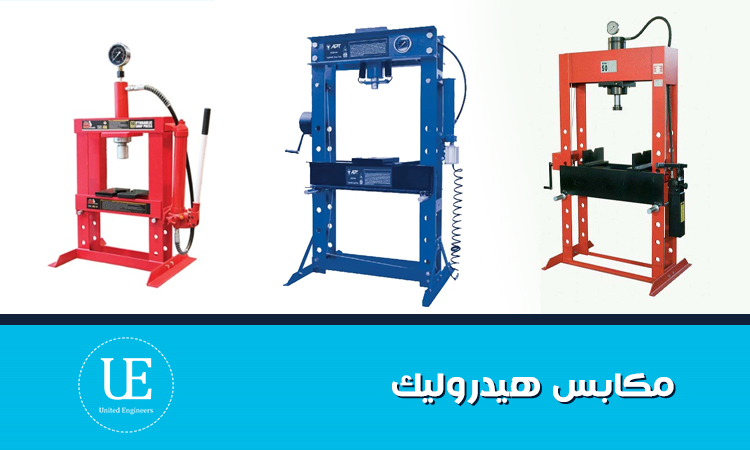
hydraulic press machine for heavy industrial applications
hydraulic press machine are widely used in industrial fields to perform heavy processing work with high efficiency, as they rely on the principle of converting a simple force into a large pressure through the fluid confined inside the hydraulic cylinder.
These machines are characterized by their ability to process multiple types of materials such as metals, plastics, wood, rubber, and others. Their uses include metal forming, molding, bending, hammering, sheet drawing, cold extrusion, calendering, edge forming, printing, in addition to metal powder applications.
The hydraulic press is essential equipment in many industries, most notably the manufacture of electrical appliances, car parts, railways, knives, and aircraft.
This article presents a comprehensive guide to hydraulic presses, including their definition, how they work, their history of development, their components, their different types, operating principles, and their most important areas of use.
What are hydraulic pistons?

hydraulic press machine are devices that rely on hydraulic fluid to generate a large compressive force over a small surface area. They are mainly used in metal processing and forming operations. Hydraulic press sizes range from relatively small table presses to giant presses that can reach 500 tons or more. Large presses can be designed for applications with low loads, while small presses are used in applications that require high loads and greater precision.
It is composed of Hydraulic Press Services Primarily consisting of the frame and base, along with the power and control systems, it also relies on a hydraulic cylinder to generate the compressive force, and operates according to Pascal's law. Hydraulic power systems are characterized by their high flexibility and customizability, enabling innovative engineering designs to suit various industrial uses.
In the mechanism of operation, the piston applies pressure to the hydraulic fluid, and this pressure is transmitted equally in all directions within the confined fluid, resulting in the generation of a uniform and smooth mechanical force applied to the piston.
Hydraulic presses are widely used in industry for metal forming, straightening, and crushing, capable of generating loads of up to 10,000 tons. They are also used for compressing or separating materials, forming metal parts, and bending and straightening materials. The bending press is one of the most common types used in bending operations.
The hydraulic press operates on Pascal’s principle, which states that any pressure applied to a confined fluid is transmitted equally to all parts of the fluid. Thanks to this, hydraulic presses play a pivotal role in the manufacturing, assembly, and production of machine components and commercial and industrial parts, especially in sheet metal industries such as drawing, deep drawing, punching, and shearing.Read more also: Cable tray prices
Hydraulic Cable Presses
hydraulic press machine are essential tools in cable extension and installation work, as they ensure strong and even pressure that provides secure and reliable connection, while maintaining electrical connection efficiency and reducing power loss.
It is characterized by its multiple sizes and ability to handle various types and sizes of cables, making it suitable for use in industrial projects, power stations, and infrastructure networks. High-quality hydraulic cable presses with diverse options are available from United Engineers Company, which provides integrated solutions that meet performance and safety requirements according to the highest standards.
What are the types of hydraulic presses?

Although there is no single, definitive number, hydraulic presses are mostly classified based on their frame structure. The main types are the C-frame (or gap frame), the H-frame (or four-column frame), the straight-sided press, and the less common horizontal press. These designs are then customized based on their intended function, such as forging, stamping, or compression forming.
The "type" of a hydraulic press is primarily defined by its structure; this physical structure is the most important factor because it determines the machine's load-bearing capacity, rigidity, and overall suitability for manufacturing processes.Specific.
- Basic classification: Frame construction
- The frame is the backbone of the piston. Its design determines how it handles the enormous forces generated during operation and determines the type of work it can perform effectively.
- C-shaped tire piston (gap tire)
- The C-shaped frame press has a distinctive "C" shape. The working area is open on three sides, providing excellent access for loading and unloading and automation integration.
- Hydraulic presses are typically used for applications requiring less load. Their open design makes them ideal for assembly, single-station stamping, and tasks where operators need easy access to the die area.
- H-shaped frame piston (four columns)
- The H-frame press, also known as a four-column press, provides a more rigid structure and even support. The press and base plate are supported by four columns, ensuring even force distribution across the workpiece.
- This design is the standard for higher load applications. H-frames are commonly used for molding, deep drawing, and other forming work that requires great strength and stability over a large surface area.
- straight-sided piston
- Straight-sided pistons are an evolution of H-frame designs, engineered for maximum rigidity and precision. They utilize rigid steel frames or prestressed tension bars to create an exceptionally strong, box-like structure.
- These machines are designed to minimize frame deflection under load, making them essential for high-precision stamping, incremental die-casting, and deep drawing operations where consistent accuracy is critical. They represent the pinnacle of performance and rigidity.
- horizontal piston
- As the name suggests, these pistons operate horizontally rather than vertically; this orientation is reserved for specific tasks that would be impractical on a vertical piston.
Common applications include straightening long columns or boards, pressing wheels or bearings onto axles, and other assembly operations on rectangular parts.
Hydraulic press manufacturing

The hydraulic piston is manufactured with an H-shaped structure in accordance with European CE safety standards, and it includes two locking cylinders that automatically move into position when the sliding parts reach the top of the space.
It is also equipped with front and rear light sensors that automatically shut off if any object approaches the operating area, thus enhancing the level of safety during use.
The machine's design is based on a welded steel frame that has undergone special heat treatment to increase durability and stability, while the pressing structure is developed using an advanced engineering design that has undergone careful analysis and optimization processes to ensure the highest operational efficiency.
The hydraulic press features an advanced hydraulic system that reduces the risk of oil leakage and provides high vibration resistance along with low power consumption.levelNoise during operation.
ACCURL's four-column hydraulic presses are designed to meet multiple safety requirements in accordance with international standards EN292:1994, EN60204:1994 and NR12, and are classified as Level IV safety products.
The metal processing machine comes equipped with a protective fence and an interlocking safety system to ensure user safety, in addition to an on/off switch.With handleMobile design ensures safe and easy control during operation.
Read more about: iron rack price
Prices of hydraulic presses for sale in Egypt
Prices for hydraulic presses for sale in Egypt vary according to several key factors, including:
- Piston capacity.
- Operating load.
- Machine size.
- Type of industrial use.
In addition to the quality of raw materials used in manufacturing and the level of safety systems and integrated technology, the country of origin and after-sales services such as warranty, maintenance, and spare parts availability also affect the final cost. United Engineers Company is committed to ensuring this.unitedengineer We provide hydraulic presses with multiple specifications to suit various industrial needs, along with technical advice to help customers choose the optimal solution in terms of performance and long-term efficiency